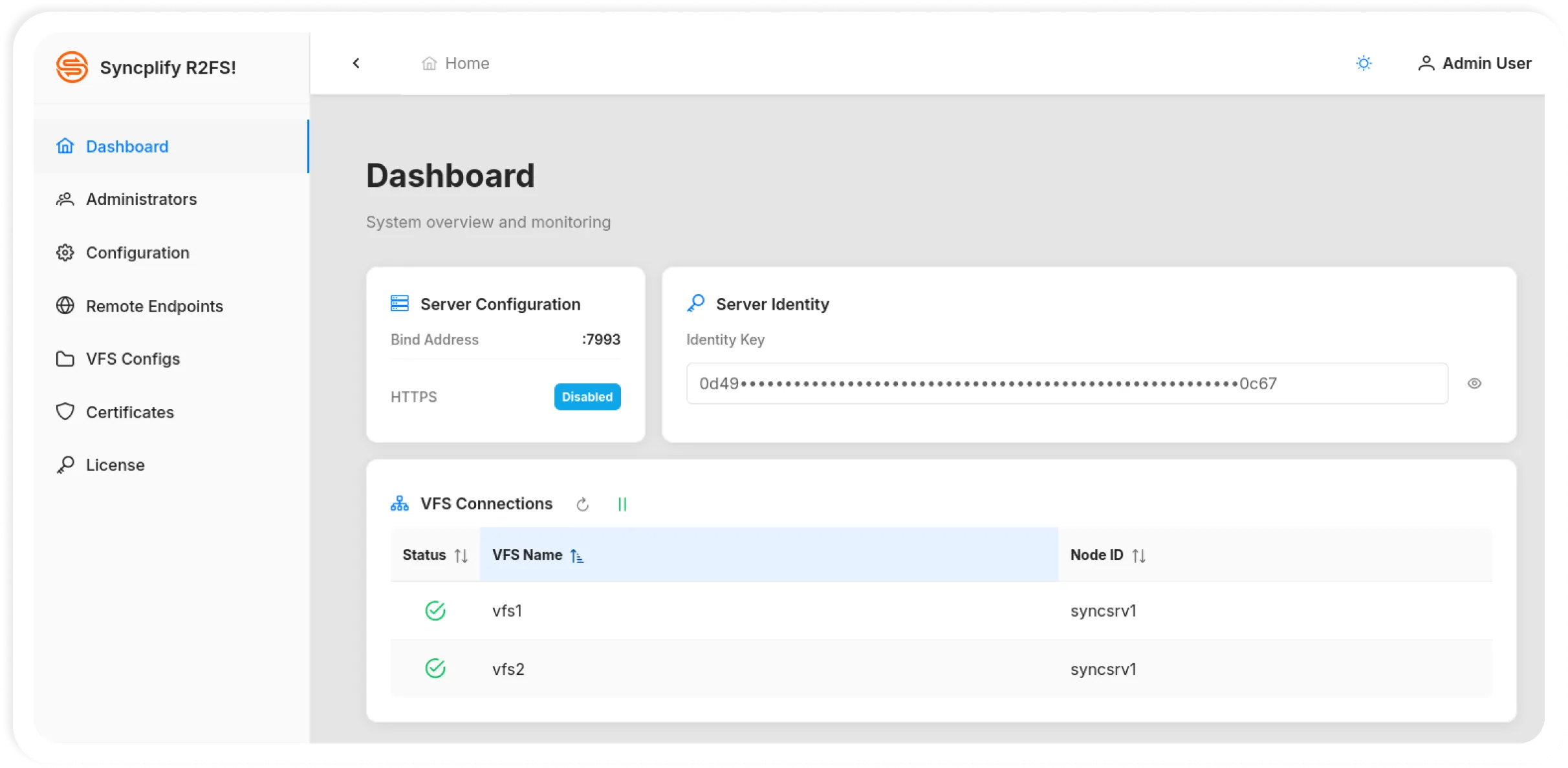
Introducing Syncplify R2FS! Reverse-Remote File System for DMZ SFTP Architecture

Syncplify R2FS! is a secure, remote file system add-on for Syncplify Server! designed for advanced DMZ SFTP environments and hardened perimeter deployments. Using reverse-connection architecture, R2FS! eliminates the need for open inbound firewall ports by having internal storage systems initiate outbound connections to the DMZ, enabling safer and more resilient file transfer infrastructure.

How R2FS! works

R2FS! enhances security by allowing the Virtual File System (VFS) to initiate an outbound connection toward the Syncplify Server! operating as a DMZ SFTP server. This design removes the requirement for inbound firewall rules and establishes a controlled, policy-driven communication model.

Secure Outbound Connection

Syncplify R2FS! initiates an outbound connection to the Syncplify Server! deployed in the DMZ, creating a hardened dmz sftp environment without exposing internal systems to inbound traffic. This reverse SFTP connection model strengthens perimeter defense by preventing unsolicited inbound access while preserving seamless file transfer functionality.

Seamless Integration with Storage

Once the secure outbound session is established, Syncplify R2FS! manages file operations inside the LAN securely and efficiently. Data flows between client endpoints, the DMZ SFTP server, and internal storage systems without requiring firewall exceptions that weaken your defensive posture.

Enhanced Scalability

In scalable deployments, a load balancer distributes client requests across multiple Syncplify Server! nodes operating in the DMZ. This clustered dmz sftp server configuration improves performance and redundancy under high traffic loads.

Secure Outbound Connections

Each R2FS node establishes outbound connections to the DMZ server nodes, maintaining a closed inbound firewall posture. This architecture aligns with zero-trust file transfer topology principles by allowing only controlled outbound communication from trusted internal systems.

Dual Syncplify R2FS Nodes

In this configuration, two Syncplify R2FS nodes within the LAN initiate outbound connections to Syncplify Server! instances in the DMZ. By eliminating inbound firewall exposure, this design strengthens the overall perimeter security model while maintaining operational continuity.

Distributed Storage for High Availability

R2FS nodes connect to distributed or high-availability storage systems to ensure redundancy and uninterrupted file access. Even if a storage node fails, the system continues operating without compromising the integrity of your reverse-connection architecture.

Two-Way Functionality: Visualized Flow

The architectural flow of R2FS! is represented through directional arrows within the system diagram, illustrating how a hardened reverse SFTP connection model operates in practice.

Initial Connection (Green Arrow)

VFS nodes inside the LAN initiate outbound connections toward Syncplify Server! nodes in the DMZ. Because the connection originates internally, there are no inbound firewall ports required. This is the foundation of the R2FS reverse architecture and the core principle behind its zero-exposure model.

Data Flow (White Arrows)

After the outbound channel is established, communication becomes bidirectional within the secure session. VFS nodes and DMZ server nodes exchange data as required for file transfer and storage operations while preserving a perimeter that blocks unsolicited inbound access.

Key Features of Syncplify R2FS!

With flexible deployment and integration into high-availability storage systems, R2FS! enables a hardened dmz sftp server configuration tailored to enterprise and regulated environments.

Reverse Connection

Traditional file system designs require open inbound firewall ports, increasing exposure risk. R2FS! reverses the connection flow by establishing outbound connectivity from the LAN toward the DMZ SFTP server, eliminating inbound port requirements and reinforcing perimeter security.

Remote Deployment Flexibility

R2FS! supports detached and remote deployments across distributed infrastructure. Whether operating a single-node configuration or a multi-node dmz sftp cluster, the architecture adapts to evolving enterprise requirements without sacrificing defensive posture.

High Availability and Scalability

R2FS! integrates seamlessly with distributed and HA storage backends, ensuring that file operations remain continuously available. Multiple storage nodes can be configured for redundancy, supporting enterprise-grade resilience within a zero-trust file transfer topology.

Seamless Integration

R2FS! integrates directly into the existing Syncplify Server! deployments without disrupting workflows. It operates as an architectural enhancement that strengthens your perimeter security layer without requiring downtime or complex reconfiguration

The Benefits of Syncplify R2FS!

Syncplify R2FS! introduces a safer and more controlled approach to managing file transfers within perimeter-sensitive environments.

Enhanced Security

By reversing the traditional connection model, R2FS! eliminates exposure from open inbound firewall ports. Internal VFS nodes initiate outbound sessions toward the DMZ SFTP server, preventing inbound attack vectors and aligning with modern security standards.

Flexible Configurations

From single-node implementations to complex, multi-storage enterprise environments, R2FS! adapts to your infrastructure. Whether deployed in finance, healthcare, or government sectors, the DMZ SFTP architecture remains consistent and defensible.

Reduced Infrastructure Complexity

Firewall configurations become simpler and more secure. Removing inbound port requirements reduces misconfiguration risk and strengthens compliance alignment in environments requiring strict network segmentation.

Optimized for Distributed Environments

R2FS! supports cloud-integrated and distributed infrastructure models while maintaining a unified file system layer. It is particularly suited for organizations implementing secure perimeter isolation, regulatory compliance controls, or multi-site deployments.

How to Set Up Syncplify R2FS!

Install Syncplify R2FS!

Install Syncplify R2FS! within your LAN environment, either as a single node or in a clustered configuration aligned with your perimeter security architecture.

Connect R2FS! to Syncplify Server!

Configure Outbound Connections

Attach Storage Backends

Install Syncplify R2FS

Connect R2FS! to Syncplify Server!

After installation, configure outbound connectivity from R2FS! nodes to one or more Syncplify Server! instances deployed as DMZ SFTP servers. Only outbound traffic is required.

Configure Outbound Connections

Attach Storage Backends

Install Syncplify R2FS

Deploy R2FS Nodes

Configure Outbound Connections

Configure each R2FS node to initiate outbound sessions as illustrated in the architectural diagram. This ensures no inbound firewall ports are exposed while maintaining secure file operations.

Attach Storage Backends

Install Syncplify R2FS

Deploy R2FS Nodes

Configure Outbound Connections

Attach Storage Backends

Attach the R2FS nodes to your storage backends, whether standalone storage devices or distributed HA systems, to guarantee redundancy and scalability.

Built for Security Architects and Regulated Environments

Modern security architecture no longer tolerates unnecessary exposure. Organizations operating in finance, healthcare, defense, and government sectors require infrastructure that aligns with strict segmentation policies and advanced threat models. A traditional file transfer deployment that depends on inbound firewall rules is increasingly viewed as a liability. Syncplify R2FS! enables a hardened DMZ SFTP architecture that aligns with zero-trust network principles. By eliminating inbound exposure and relying exclusively on outbound-initiated communication, the platform significantly reduces the attack surface while maintaining operational continuity.

For security architects, this approach simplifies compliance alignment. Network diagrams become cleaner. Firewall rule sets become smaller. External penetration surfaces are minimized. When audits require proof of controlled connectivity, a reverse SFTP connection model provides measurable architectural clarity. This design is especially valuable in regulated industries where infrastructure must comply with strict internal security frameworks, segmented network zones, and formal risk assessment methodologies. Because the internal VFS nodes initiate outbound sessions toward the dmz sftp server, the system enforces clear directional trust boundaries.

Beyond regulatory considerations, the model also supports operational scalability. Enterprises can expand storage clusters, add additional DMZ nodes, and increase throughput without introducing new inbound exposure points. The result is a resilient, scalable, and defensible DMZ SFTP infrastructure built for long-term stability. R2FS! is not merely an add-on. It is an architectural upgrade that transforms how perimeter-secured file transfer systems are designed and deployed.

Ready to revolutionize your file transfer infrastructure?

Add Syncplify R2FS! to your Syncplify Server! deployment to implement hardened secure file transfer built on reverse connectivity principles. By eliminating inbound firewall exposure and adopting a zero-trust topology where internal systems control all connections, your organization gains enhanced perimeter security without sacrificing performance or flexibility.
User-Friendly Interface
Download for Windows and Linux
Deploy from AWS Marketplace
Deploy with one click from the AWS Marketplace
Automatic Updates
A white forward arrow